


Home Staging in der Praxis – Definition, Wirkung und Mehrwert
Home Staging ist die professionelle Inszenierung einer Immobilie für den Verkauf. Ziel: schneller verkaufen, höhere Gebote erzielen und Einwände reduzieren – mit einem schlanken Budget und ohne bauliche Veränderungen. Bei localis setzen wir Home Staging als strategisches Vermarktungsinstrument ein, das messbar zur Aufwertung von Immobilien beiträgt – von Eigentumswohnungen in Düsseldorf über Pariser Pied-à-terres bis zu internationalen Luxus- und Anlageobjekten.
"29 % der Immobilienmakler berichten, dass Home Staging den Angebotspreis um 1–10 % erhöht." - Source
Was bedeutet Home Staging heute? (Abgrenzung zu Renovierung/Styling)
Home Staging ist marktorientiertes Immobilien-Branding. Es positioniert Räume so, dass die Zielgruppe den maximalen Nutzen intuitiv erkennt – online wie vor Ort. Es kombiniert Reinigung, kleine Reparaturen, Lichtkonzept, Möblierung, Textilien, Farb- und Duftakzente sowie Bildsprache für Exposé und Portale.
Abgrenzung:
Renovierung: Beseitigt Substanz- und Ausstattungsmängel (baulich/technisch), höheres Budget, langfristige Wertsteigerung. Home Staging arbeitet „oberflächennah“ und temporär.
Interior Styling: Individuelle Geschmacksoptimierung für Eigennutzer. Home Staging hingegen ist neutral, zielgruppen- und ROI-getrieben und dient der Vermarktung, nicht der persönlichen Nutzung.
Ergebnis: Das Objekt wirkt größer, heller, hochwertiger – ohne Grundrissänderung. Genau darin liegt die effiziente Aufwertung von Immobilien.
Warum es wirkt: Psychologie, Wahrnehmung und Kaufentscheidungen
Kaufentscheidungen entstehen emotional, werden rational begründet. Home Staging nutzt zentrale psychologische Hebel:
Primacy Effect: Der erste Eindruck (online und beim Eintreten) prägt den gesamten Entscheidungsprozess.
Kognitive Entlastung: Entpersonalisierte, aufgeräumte Räume senken mentale Reibung – Interessenten „sehen“ schneller ihr eigenes Leben in der Immobilie.
Größen- und Proportionswahrnehmung: Richtig skalierte Möbel und Blickachsen lassen Räume größer und funktionaler erscheinen.
Licht- und Farbwahrnehmung: Warmweißes Licht, harmonisierte Farbwerte und Texturen erzeugen Qualitäts- und Wohlfühleffekte.
Verknappung/Sicherheit: Ein professioneller Auftritt signalisiert Nachfrage und Pflegezustand, was Preisverhandlungen verkürzt und Sicherheitsgefühl erhöht.
Kurz: Staging von Immobilien macht Potenzial sichtbar, senkt Einwände und beschleunigt Entscheidungen.
Für wen lohnt es sich? Eigennutzer, Kapitalanleger, Luxus- und Auslandsobjekte
Eigennutzer (Verkäufer): Ideal bei bewohnten, leerstehenden oder stark personalisierten Objekten. Wenig Budget, starke Wirkung – perfekte Vorbereitung für hochwertige Fotografie und Besichtigungen.
Kapitalanleger: Relevante KPI-Effekte (Days on Market, Preisreduktionen, Verhandlungsspannen). Besonders wirksam bei Mikro-Apartments, City-Wohnungen, möblierten Konzepten und Musterwohnungen in Mehrfamilienhäusern.
Luxusobjekte: High-End-Klientel erwartet Inszenierung auf Gallery-Niveau. Staging definiert Lifestyle, klärt Raumfunktionen und setzt Qualitätsschwerpunkte (Materialität, Kunst, Licht).
Auslandsobjekte: Internationale Käufer treffen Entscheidungen häufig remote. Erstklassige Inszenierung plus Visual Assets (Hero Shots, 3D/Video) erhöhen Vertrauen und die Abschlussquote. localis berät und koordiniert Staging in Düsseldorf, Paris sowie ausgewählten Märkten wie Zypern, Schweiz und Dubai.
Projektentwickler/Bestandsstrategen: Show-Units und typisierte Ausstattungslinien signalisieren Qualitätsstandard, beschleunigen Vorverkäufe und belegen Miet-/Preisniveaus.
Einordnung: Aufwertung von Immobilien-Werten ohne Grundrisse zu verändern
Home Staging ist ein CapEx-light-Ansatz der Aufwertung von Immobilien-Werten:
Keine statischen Eingriffe, keine Genehmigungen – dennoch deutlicher Uplift in der wahrgenommenen Qualität.
Werttreiber: bessere Fotoperformance, mehr qualifizierte Anfragen, höhere Besichtigungs-zu-Angebot-Quote, weniger Preisnachlässe.
Repositionierung: Durch Zielgruppen-Inszenierung wird ein Objekt in ein höheres Erwartungs- und Preissegment „übersetzt“, ohne bauliche Maßnahmen.
Nachhaltig: Temporär, reversibel, nutzungsneutral – ideal in Märkten mit sensibler Rendite- und Risikosteuerung.
Damit stärkt Home Staging die Marke der Immobilie, nicht nur ihre Optik – ein klarer Hebel für Immobilien-Werte.
Zielbild: Kürzere Vermarktungszeit, höherer Verkaufspreis, weniger Preisverhandlungen
Mit professioneller Umsetzung und realistischem Angebotspreis lässt sich das Zielbild konsequent erreichen:
Kürzere Vermarktungszeit: Bessere Online-Coverage und emotionale Passung beschleunigen die Entscheidung.
Höherer Verkaufspreis: Höhere Wertwahrnehmung, stärkere Zahlungsbereitschaft – insbesondere in vergleichsintensiven Märkten.
Weniger Preisverhandlungen: Sauber inszenierte, gepflegte Immobilien erzeugen Vertrauen und reduzieren Abschläge für „Ungewissheiten“.
Bessere Käuferqualität: Mehr finanzierungsstarke, ernsthafte Interessenten – effizientere Prozesse bis zum Notartermin.
localis orchestriert diesen Prozess ganzheitlich: Strategie, Zielgruppen-Definition, Budgetierung, Auswahl zertifizierter Partner, Qualitätskontrolle und Vermarktung. Unser Service Immobilien bündelt alle Bausteine – von Home Staging und Premium-Fotografie bis zu Off-Market-Distribution – für spürbare Aufwertung von Immobilien und messbaren ROI.
Der erste Eindruck entsteht online: Psychologie, Listing-Qualität und Bildführung
„Für den ersten Eindruck gibt es keine zweite Chance – online entscheidet oft das erste Foto in Sekunden.“
In der Praxis beginnt Home Staging heute im Listing: Wer die Bildführung, die Reihenfolge der Räume und die visuelle Konsistenz meistert, steigert Klickrate, Verweildauer und Anfragen – die Grundlage für weniger Preisverhandlungen und höhere Immobilien-Werte. localis setzt hier auf Premium-Bildwelten, die die Aufwertung von Immobilien messbar machen: vom Hero-Shot bis zum 3D-Rundgang.
So scannen Kaufinteressenten Exposés: Blickverlauf, Hauptbild, Reihenfolge der Räume
Kaufinteressenten „skimmen“ – erst Bilder, dann Fakten. Entscheidend sind die ersten fünf Sekunden und die ersten fünf Bilder.
Empfehlung für den Blickverlauf:
Bild 1: Hero-Shot (Wohn-/Essbereich mit klarer Achse zum Licht, definierte Sitz-/Esszone, dezente Deko).
Bild 2: Key Feature (Küche mit hochwertiger Arbeitsfläche/Fronten, aufgeräumt, akzentuiertes Licht).
Bild 3: Primary Bedroom (Hotel-Logik: Kopfteil als Ankerpunkt, symmetrische Nachttische/Leuchten).
Bild 4: Außenraum/Highlight (Balkon, Terrasse, Aussicht, Garten – „Lifestyle“-Bild).
Bild 5: Bestes Bad (helle, warme Tonalität, Gläser klar, Textilien neutral).
Danach: Sekundärräume, Arbeitsbereich, Abstell-/Hauswirtschaftsraum nur, wenn gepflegt; am Ende Grundriss.
Reihenfolge der Räume:
Vom größten, hellsten Raum zum spezifischen Detail. Keine „Überraschungen“ – das Exposé soll die Besichtigung logisch vorbereiten.
Pro Raum 1–2 starke Perspektiven statt 5 redundante. Das stärkt die Wahrnehmung von Qualität und Klarheit.
Visuelles Storytelling: Licht, Linienführung, Ankerpunkte und Farbharmonie
Staging von Immobilien ist visuelle Strategie: Bilder führen das Auge, definieren Proportion und erzeugen Begehrlichkeit.
Lichtführung:
Tageslicht priorisieren; ergänzend warmweiß 3000–3500 K. Mischlicht vermeiden.
Gegenlicht kontrolliert nutzen (leichte HDR-Reserve), aber ohne „überzogenes“ HDR.
Linienführung und Perspektive:
Senkrechten gerade halten (Architektur „steht“ – Vertrauen).
2-Punkt-Perspektive oder 45°-Winkel für Raumtiefe; führende Linien (Bodenfugen, Arbeitsplatte) zur Bildmitte.
Ankerpunkte:
Ein markanter Fokus je Bild (Kopfteil, Esstisch-Setting, Kücheninsel). Dekoration als Taktgeber, nicht als Ablenkung.
Farbharmonie:
60–30–10-Regel: 60 % neutrale Basis (Wände/Böden), 30 % Möblierung in warmen, zeitlosen Tönen, 10 % Akzente (Kissen, Kunst, Grün).
Konsistente Weißbalance über das gesamte Listing – Professionalität wirkt wie ein Qualitätssiegel.
Content-Pakete, die konvertieren: Premium-Fotografie, Grundriss, 3D/360°, Textmodule
localis setzt auf modulare Content-Bausteine, die je nach Zielgruppe skalieren – vom Eigennutzer bis zum Kapitalanleger.
Premium-Fotografie:
14–22 kuratierte Bilder, kein „Bilderfriedhof“. Jedes Bild hat eine Funktion in der Story.
Key Shots: Wohn-/Essbereich, Primary Bedroom, Küche, Bad, Außenraum, Highlight-Detail (Materialität).
Grundriss (annotiert):
Klarer Maßstab, Möblierungsvorschläge, Zonen/Wege, Himmelsrichtungen. Optional zwei Nutzungsvarianten (z. B. Homeoffice vs. Kinderzimmer).
3D/360°:
Für internationale Käufer und Investoren essenziell (Remote-Entscheidungen). Integration direkt im Exposé und auf Portalen.
Short-Video/Teaser:
20–40 Sekunden, Übergänge Raumfolge entsprechend der Fotostory; ideale Ergänzung für Social/Portale.
Textmodule:
Klar strukturiert: Lage-Anchor (3–5 Sätze), USP-Liste (5 Bulletpoints), Ausstattung (Material/Marke), „Hidden Values“ (Energie, Schallschutz, Stauraum), Investment-Case (Mieten/Rendite, wo relevant).
Keyword-nah formuliert für SEO und Marktplatz-Algorithmen: staging immobilien, aufwertung immobilien, immobilien werte, service immobilien.
Fehler vermeiden: Weitwinkel-Übertreibungen, Farbstiche, unklare Raumfunktionen
Weitwinkel-Übertreibung:
Brennweite realistisch halten (idealerweise 16–24 mm Vollformat). Verzerrungen/„Bowlingbahn“-Effekt mindern Vertrauen.
Farbstiche und Mischlicht:
Einheitliche Lichttemperatur; Weißabgleich pro Serie. Grünstich von Außengrün durch Vorhänge/Belichtung kontrollieren.
Unklare Raumfunktionen:
Jeder Raum hat eine klare Aufgabe (Schlafen, Arbeiten, Essen). Doppelbelegungen verwirren (z. B. Büro plus Gästezimmer ohne klare Priorität).
Überdeko/Personalisierung:
Keine Bildflächen „überladen“. Persönliches (Porträts, Trophäen) entfernen – kognitive Entlastung vor Ästhetik.
Unfertige Bilder:
Kabel, Putzutensilien, sichtbare Mängel vermeiden oder offen kommunizieren. Glaubwürdigkeit schlägt „Kaschieren“.
localis orchestriert die gesamte Content-Produktion als Service Immobilien: vom Home Staging über Premium-Fotografie bis zur 3D/360°-Tour, inklusive redaktioneller Exposé-Texte und SEO-Optimierung. Ergebnis: bessere Bildperformance, mehr qualifizierte Leads und eine messbare Aufwertung von Immobilien – online, bevor die erste Besichtigung beginnt.
Budget, Kostenmodelle und ROI: Vom DIY-Update bis zum Profi-Staging
Home Staging ist einer der effizientesten Hebel zur Aufwertung Immobilien – mit planbaren Budgets und klarer ROI-Mechanik. Ob DIY-Update für Fotos oder kuratiertes Profi-Staging: Entscheidend ist die richtige Staffelung nach Objektklasse, Zielgruppe und Vermarktungsziel. localis bündelt den Service Immobilien in einem strukturierten Paket: Budgetierung, Maßnahmenmix, Partnersteuerung und Erfolgskontrolle.
"Branchenrichtwert: Professionelles Home Staging kostet in der Regel 1–3 % des Verkaufspreises und amortisiert sich häufig über kürzere Vermarktungszeiten und höhere Gebote." - Source
Kostenkomponenten: Beratung, Möbel/Deko (Miete), Logistik, Handwerk, Reinigung, Außenbereich
Beratung & Konzeption: Zielgruppen-Definition, Raum- und Fotostory, Maßnahmenplan, Budgetierung.
Möbel/Deko (Miete): Sofas, Tische, Betten, Textilien, Kunst/Accessoires – meist inkl. Auf- und Abbau.
Logistik: Transport, Lager, Handling vor Ort; ggf. Etagen-/Sonderaufwand.
Handwerk & Kleinreparaturen: Malerarbeiten (Neutralisierung), Silikonfugen, Beschläge, Leuchten, kleinere Ausbesserungen.
Reinigung: Grundreinigung vor Fotografie/Besichtigungen; Glas- und Sanitärfokus.
Außenbereich: Vorgarten/Curb Appeal, Balkon/Terrasse, einfache Bepflanzung, Möblierung (Outdoorset).
Optional: Premium-Fotografie, 3D/360°, Grundriss-Redesign, Energieausweis, Styling für Besichtigungen.
Budgetrahmen nach Objektklasse: Standard, Premium, Luxus, Auslandsobjekte
Standard: Fokus auf Key Rooms (Wohn-/Essbereich, Hauptschlafzimmer, bestes Bad), neutrale Farbwelt, aufgeräumte Technikflächen. Ziel: schnelle Marktfähigkeit bei moderatem Budget.
Premium: Durchgängige Linie mit hochwertiger Materialität, Beleuchtungskonzept, konsistente Bildführung für Portale. Ziel: höhere Zahlungsbereitschaft, weniger Verhandlung.
Luxus: Kuratierte Auswahl (Designmöbel, Kunst), präzise Lichtinszenierung, editierte Details. Ziel: Positionierung im oberen Preissegment, internationale Käuferansprache.
Auslands-/Investmentobjekte: Show-Unit-Logik, digitale Assets (3D/360°, Video), logistische Redundanz. Ziel: Remote-Entscheidungen ermöglichen, Absorptionsrate steigern.
ROI-Mechanik: Wie 1–3 % Staging-Budget 5–15 % Mehrerlös hebeln können
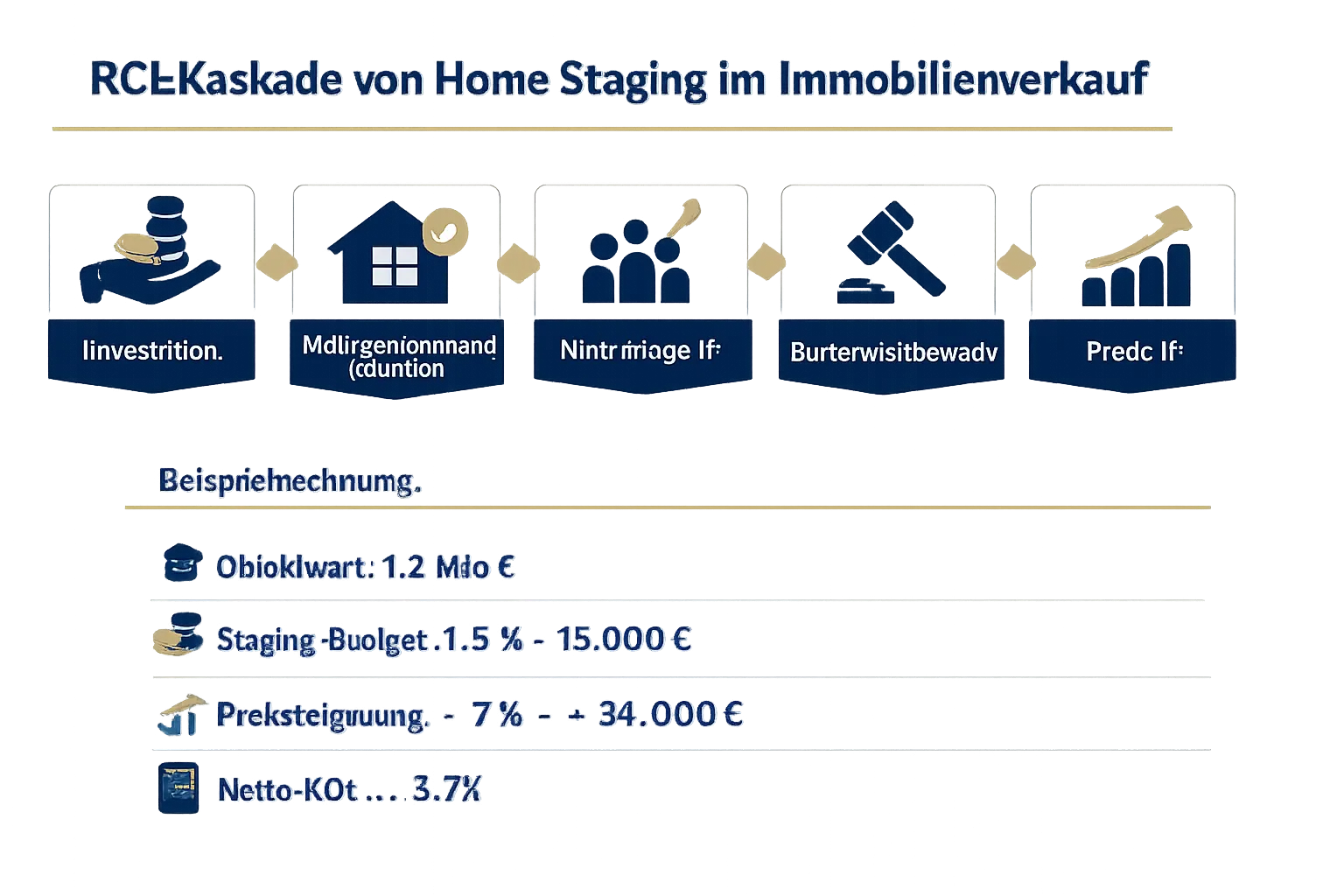
Die Hebelkette im Staging von Immobilien ist linear messbar:
Investition (1–3 %): Temporäre Aufwertung statt baulicher Maßnahmen.
Wahrgenommene Qualität: Höhere Bild-CTR, längere Verweildauer, mehr qualifizierte Anfragen.
Nachfrage ↑: Mehr Besichtigungen, bessere Käuferqualität.
Bieterwettbewerb: Konkurrenzdruck reduziert Nachlässe.
Preis ↑: Realistischer Angebotspreis + Aufschlag durch hochwertige Wahrnehmung.
Beispielrechnung (1,2 Mio € Zielpreis): 1,5 % Budget = 18.000 €; +7 % Preis = +84.000 €; Netto-Mehrerlös ≈ 66.000 €; ROI ≈ 3,7x.
Break-even und Risikoabsicherung: Was tun bei Marktveränderungen?
Break-even-Logik: Uplift (%) ≥ Budget (%) – bei 1,5 % Budget genügt ein realisierter Aufpreis von ≥1,5 %, um kostenneutral zu sein; alles darüber ist Gewinn.
Risikoabsicherung:
Gestaffeltes Vorgehen: Erst Key Rooms, dann Erweiterung nach Resonanz.
Kürzere Mietdauer mit Verlängerungsoption (8–12 Wochen als Standard).
Flexible Pakete: Wechsel von Accessoires/Farbakzenten nach 3–4 Wochen zur Reaktivierung in Portalen.
Preisstrategie: Realistischer Angebotspreis; kein Staging ersetzt eine marktgerechte Preisfindung.
Exit-Plan: Rückbau und Repositionierung (neue Leadshots, frische Headline/Keywords) bei Marktschwenk.
localis begleitet die Budget- und ROI-Steuerung end-to-end – von der initialen Kalkulation bis zur Vermarktungsoptimierung. Das Ergebnis: planbare Aufwertung der Immobilien-Werte, schnellere Transaktionen und weniger Preiszugeständnisse.
Budget- und ROI-Staffel nach Objektklasse
Objektklasse | Typische Maßnahmen (Kurzliste) | Budgetkorridor in % vom Zielpreis | Erwartbarer Mehrerlös-Korridor | Hinweise |
|---|---|---|---|---|
Standard | Neutralisierung (Malerarbeiten), Key Rooms möblieren (Wohnen/Essen, Primary Bedroom), Licht, Textilien, Pflanzen | 0,8–1,5 % | +3–8 % | Möbelmiete i. d. R. 8–12 Wochen; Fokus auf Fotoperformance |
Premium | Durchgängiges Konzept, Design-Akzente, konsistente Lichttemperatur, Küchen-/Bad-Finishing, Premium-Fotografie | 1,0–2,0 % | +5–10 % | Optional 3D/360°; zwei Grundrissvarianten für Zielgruppen |
Luxus | Kuratierte Möbel/Kunst, präzises Licht, Styling pro Raum, detailliertes Set-Design, video-ready | 1,5–3,0 % | +7–15 % | Möbelmiete 8–16 Wochen; internationale Käuferansprache |
Investment | Show-Unit, skalierbare Möblierungslinien, Branding, 3D/360°, Grundriss-Annotation | 0,8–1,8 % | +4–9 % | Mietdauer oft 12+ Wochen; Fokus auf Absorption/Preisnachlässe ↓ |
Mit localis erhalten Sie ein skalierbares Paket für staging immobilien – von der schlanken DIY-Begleitung bis zum Profi-Staging mit internationalen Partnern. So verbinden Sie schnelle Marktfähigkeit mit messbarem Mehrerlös – als Eigennutzer, Kapitalanleger oder im Luxus-/Auslandssegment.
Der 14-Tage-Plan: In zwei Wochen vom Status quo zur marktreifen Bühne
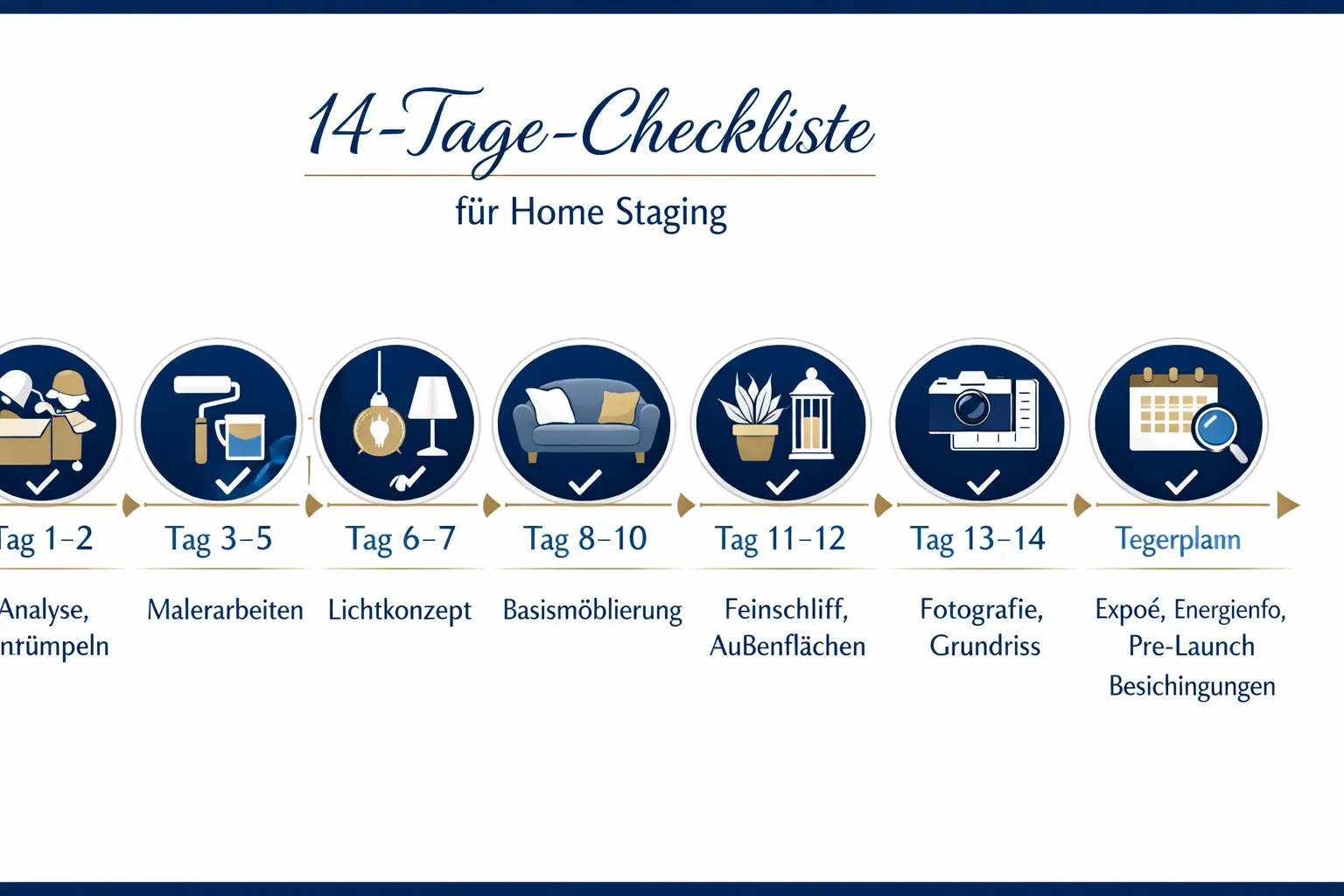
Der komprimierte Ablaufplan sorgt für Tempo und Qualität. In 14 Tagen wird Ihre Immobilie zur marktreifen Bühne – mit klaren Zuständigkeiten, fixen Deadlines und einem Maßnahmenmix, der die Aufwertung Immobilien sichtbar macht.
Tag 1–2: Analyse, Zielgruppe, Maßnahmenliste, Budget-Freigabe
Bestandsaufnahme vor Ort inkl. Fotowalk; Ermittlung von Stärken/Einwänden.
Zielgruppen-Definition (Eigennutzer vs. Anleger; Single, Paar, Familie; national/international).
Maßnahmenkatalog priorisieren: Must-haves (Neutralisierung, Licht) vs. Nice-to-haves (Kunst, Styling).
Kosten-/Zeitplan freigeben; Logistik und Handwerker-Slots buchen.
Tag 3–5: Entrümpeln/Depersonalisieren, Kleinreparaturen, Malerarbeiten in Neutralfarben
Entrümpeln, persönliche Gegenstände herausnehmen, klare Sichtachsen schaffen.
Kleinreparaturen: Silikonfugen, Griffe/Beschläge, Lichtschalter, Türknarzen.
Malerarbeiten in Off-White/Greige; Decken/Wände einheitlich für konsistente Fotografie.
Tag 6–7: Lichtkonzept, Textilien, Basismöblierung (Funktionen klären)
Warmweißes Licht (3000–3500 K), Schattenzonen auflösen, Akzentleuchten setzen.
Textilien mit Haptik: Vorhänge, Teppiche, Kissen; Geräuschkomfort beachten.
Basismöblierung nach Hotel-Logik: Primary Bedroom, Wohnen/Essen, klare Raumfunktionen.
Tag 8–10: Feinschliff (Dekor, Pflanzen, Kunst), Außenflächen/Garten, Flur-Inszenierung
Dekor als Taktgeber: 10 %-Akzentfarbe, natürliche Materialien, reduzierte Stillleben.
Pflanzen für Vitalität; Außenflächen säubern, möblieren (Balkonset, Laternen).
Flur als „Prolog“: Spiegel, Leuchte, Konsole – direkter Qualitätsimpuls.
Tag 11–12: Premium-Fotografie, Grundriss-Update, Exposé-Texte, Energieinfos
Premium-Fotos inkl. Hero-Shots und Detail-Frames; Serienfarbprofil konsistent halten.
Grundriss-Update mit Möblierungsvorschlägen und Himmelsrichtungen.
Exposé-Module: USP-Liste, Ausstattung, Lageanker, Investment-Notizen.
Energieinfos (Verbrauch/Klasse) optimiert auf Klarheit und Compliance.
Tag 13–14: Pre-Launch in Netzwerken, Terminierung der Erstbesichtigungen
Soft-Launch im Off-Market-/Maklernetzwerk von localis, Social-Teaser.
Go-live in Portalen mit idealer Veröffentlichungszeit; Terminfenster blocken.
Erstbesichtigungen clustern (Back-to-back), um Nachfrage sichtbar zu machen.
Finaler Check: Geruchs-/Lichttest, Accessoires frischen, Außenbereich prüfen.
Mit diesem 14-Tage-Fahrplan orchestriert localis die Aufwertung Ihrer Immobilien-Werte schnell und strukturiert – für maximale Wirkung ab dem ersten Bild und eine zügige, verhandlungssichere Vermarktung.
Räume mit dem größten Hebel: Wo jeder Euro die meiste Wirkung entfaltet
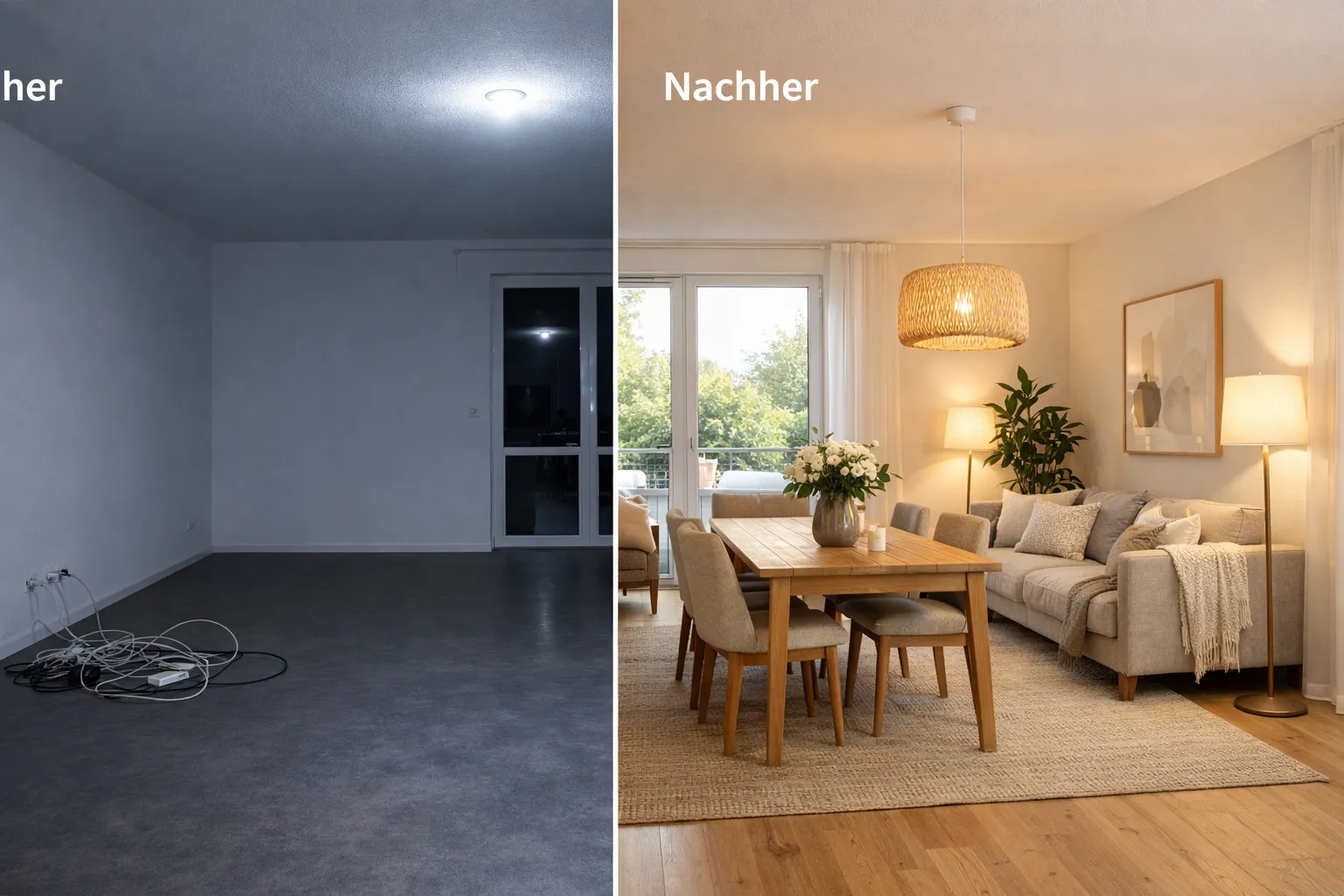
In nahezu jedem Markt sind es die gleichen Räume, die die Wahrnehmung – und damit den Preis – treiben. Mit einem gezielten Maßnahmenmix erzielen Sie die größte Aufwertung Immobilien bei minimalem Budgeteinsatz.
Wohnzimmer/Essbereich: Funktion, Fluss, Fokuspunkt (z. B. Blickachse Fenster/Kamin)
Flow herstellen: freie Zirkulation, klare Wege zwischen Sofa, Esstisch und Balkon/Terrasse.
Fokuspunkt definieren: Kamin oder Fensterfront mit Sitzgruppe/Esstisch inszenieren; Teppich als Zonierung.
Licht schichten: Deckenleuchte + Stehleuchte + indirektes Licht; warmweißes Spektrum 3000–3500 K.
Materialien & Palette: Holz, Leinen, Wolle; neutrale Basis mit 10 % Akzentfarbe.
Clutter-frei: Medien-/Kabelmanagement, reduzierte Dekoration, 1–2 Kunstakzente.
Küche & Bad: Sauberkeit, Oberflächen, Beschlagwechsel, Licht, Textilien
Tiefenreinigung: Fugen, Armaturen, Glas – Hygiene visualisieren.
Oberflächen refreshen: Arbeitsplatten ölen/pflegen, Silikon erneuern, Kalk entfernen.
Beschlagwechsel: Griffe in einheitlicher Optik (Mattschwarz/Chrom), günstiger Update-Hebel.
Licht & Spiegel: Unterbau-/Spiegelleuchten, gleichmäßige Weißbalance, Schatten reduzieren.
Textilien: Frische Handtücher, Holz-/Leinen-Accessoires; kein Plastik, keine bunten Spülmittel.
Hauptschlafzimmer: Ruhe, Symmetrie, Hotel-Anmutung
Bett als Bühne: Kopfteil als Anker, Symmetrie durch Nachttische/Leuchten.
Layering: Bettwäsche in Weiß/Greige, Plaid, 2–3 Kissen – Hotel-Look.
Stauraum suggerieren: Fronten geschlossen, keine Kleiderstapel; Spiegel für Licht.
Farben & Duft: beruhigende Töne, dezenter Duft; keine persönlichen Fotos.
Homeoffice/Nische: Nutzungs-Idee sichtbar machen
Kompaktes Set-up: schlanker Tisch, ergonomischer Stuhl, Arbeitsleuchte.
Ordnung: Kabelführung unsichtbar, 1 Technik-Item (Laptop) reicht.
Hintergrund: ruhige Wand/Kunst – Videocall-tauglich signalisiert Funktionalität.
Außenbereich/Eingang: Curb Appeal, Zuwege, Bepflanzung, Beleuchtung
Eingang: saubere Zuwege, Hausnummer/Leuchte intakt, Matte frisch.
Balkon/Terrasse: 2er-Bistroset, Laterne, Pflanzkübel; Boden reinigen.
Grünpflege: Hecken schneiden, Rasenkanten sauber, Totholz entfernen.
Abend-Option: Warmlicht-Akzente für stimmige Abendfotos/Termine.
Mit diesem Fokus steigern Sie die Attraktivität des Listings spürbar – und erzeugen genau die Bilder, die Nachfrage und Preisdynamik auslösen. localis kuratiert die Maßnahmen je Objektklasse, damit jeder Euro Staging-Budget maximalen Hebel entfaltet.
Szenarien & Strategien: Leerstand, bewohnt, Luxussegment, Investment-Case
Jedes Verkaufssetting verlangt eine eigene Staging-Strategie. Mit klaren Prioritäten, standardisierten Modulen und sauberer Offenlegung lassen sich Vermarktungszeit, Verhandlungsspielräume und Immobilien-Werte gezielt beeinflussen. localis orchestriert die passenden Bausteine – vom schlanken Ein-Tages-Styling bis zum kuratierten High-End-Setup – als Service Immobilien mit messbarer Aufwertung.
Leerstand: Möblierung als Orientierung, Akustik & Maßstab, reduzierte Palette
Leere Räume unterschätzen Käufer häufig. Maßstäbliche Basismöblierung zeigt Proportionen und Funktion, Teppiche/Vorhänge entschärfen Hall, eine neutrale Palette fokussiert auf Qualität und Licht. Ergebnis: klare Nutzungsideen, größere Raumwirkung, bessere Bildperformance.
Bewohnt: Ein-Tages-Staging, Lagerung, neutrale Styling-Schicht ohne Komfortverlust
Mit Depersonalisierung, smarter Lagerung und einer neutralen Styling-Schicht entsteht in 24–48 Stunden ein verkaufsfähiges Setting – ohne den Alltag massiv zu stören. Textilien, Lichttemperatur und ausgewählte Accessoires liefern schnelle Hebel für aufwertung immobilien.
Luxusobjekte: Kuratierte Materialien, Kunst, Duft-/Sound-Kulissen sparsam nutzen
Im Luxussegment zählt das kuratierte Gesamtbild: ikonische Stücke, hochwertige Materialien, präzise Lichtregie. Duft- und Soundkulissen nur minimal als Stimmungsträger einsetzen – Eleganz entsteht durch Reduktion. Ziel: Lifestyle definieren, ohne Substanz zu überinszenieren.
Investment/Portfolio: Standardisierte Staging-Module, Kostenkontrolle, Messbarkeit
Für Anleger und Entwickler funktionieren standardisierte Module: Show-Units, modularer Möbelpool, 3D/360° und annotierte Grundrisse. So werden KPIs (Days on Market, Preisnachlässe, Lead-Qualität) skalierbar optimiert – ein klarer Hebel für staging immobilien im Serienbetrieb.
Staging-Strategien nach Situation
Szenario | Prioritäten (Top-3) | Must-do-Maßnahmen | Budget-Hinweis | Risiko/Compliance (Transparenz, Offenlegung) |
|---|---|---|---|---|
Leerstand | 1) Raumfunktionen klären 2) Maßstab sichtbar machen 3) Licht/Akustik optimieren | Basismöblierung Wohnen/Essen + Primary Bedroom; Teppiche/Vorhänge gegen Hall; Warmweiß 3000–3500 K; 1–2 Kunst-/Grünakzente | ca. 0,8–1,8 % Zielpreis; Möbelmiete 8–12 Wochen | Keine Mängel kaschieren; Konsistenz zwischen Fotos und Realität; Mietdauer/Umfang im Exposé benennen |
Bewohnt | 1) Depersonalisierung 2) Ein-Tages-Staging 3) Lager-/Stauraum organisieren | Boxenlager/Einlagerung; neutrales Textil-/Licht-Update; Möbel-Feinschliff; Reinigungsprotokoll vor Terminen | ca. 0,3–1,0 %; Fokus auf Accessoires/Licht; punktuelle Möbelmiete | Privatsphäre: persönliche Fotos/Post entfernen; Wertsachen sichern; bekannte Mängel offenlegen; Terminfenster abstimmen |
Luxussegment | 1) Kuratierte Materialität/Kunst 2) Präzise Lichtregie 3) Reduzierte Duft-/Soundkulisse | Statement-Pieces, hochwertige Texturen; Abend-/Dämmerungsfotografie; Raumstyling mit Galerie-Logik | ca. 1,5–3,0 %; Mietdauer 8–16 Wochen; Versicherung/Transport prüfen | Provenienz und Leihverträge für Kunst; keine Irreführung durch Überinszenierung; dezente Raumdüfte deklarieren |
Investment/Portfolio | 1) Standardmodule 2) Kostenkontrolle 3) Messbarkeit (KPIs) | Show-Unit je Typ; modularer Möbelpool; 3D/360°; annotierte Grundrisse; Batch-Fotografie & Textmodule | ca. 0,8–1,8 %; Skaleneffekte bei Volumen; 12+ Wochen Mietdauer | Einheitliche Offenlegungen pro Unit; klare Kosten-/Mietmöbelkennzeichnung; technische Mängel transparent kommunizieren |
localis entwickelt für jede Situation die passende Strategie – zielgruppengenau, budgettreu und ROI-orientiert. So transformieren wir Listings in performante Vermögenswerte und heben immobilien werte mit planbarem Effekt.
Digitales Staging, 3D-Grundrisse und 360°: Chancen, Grenzen, Transparenz
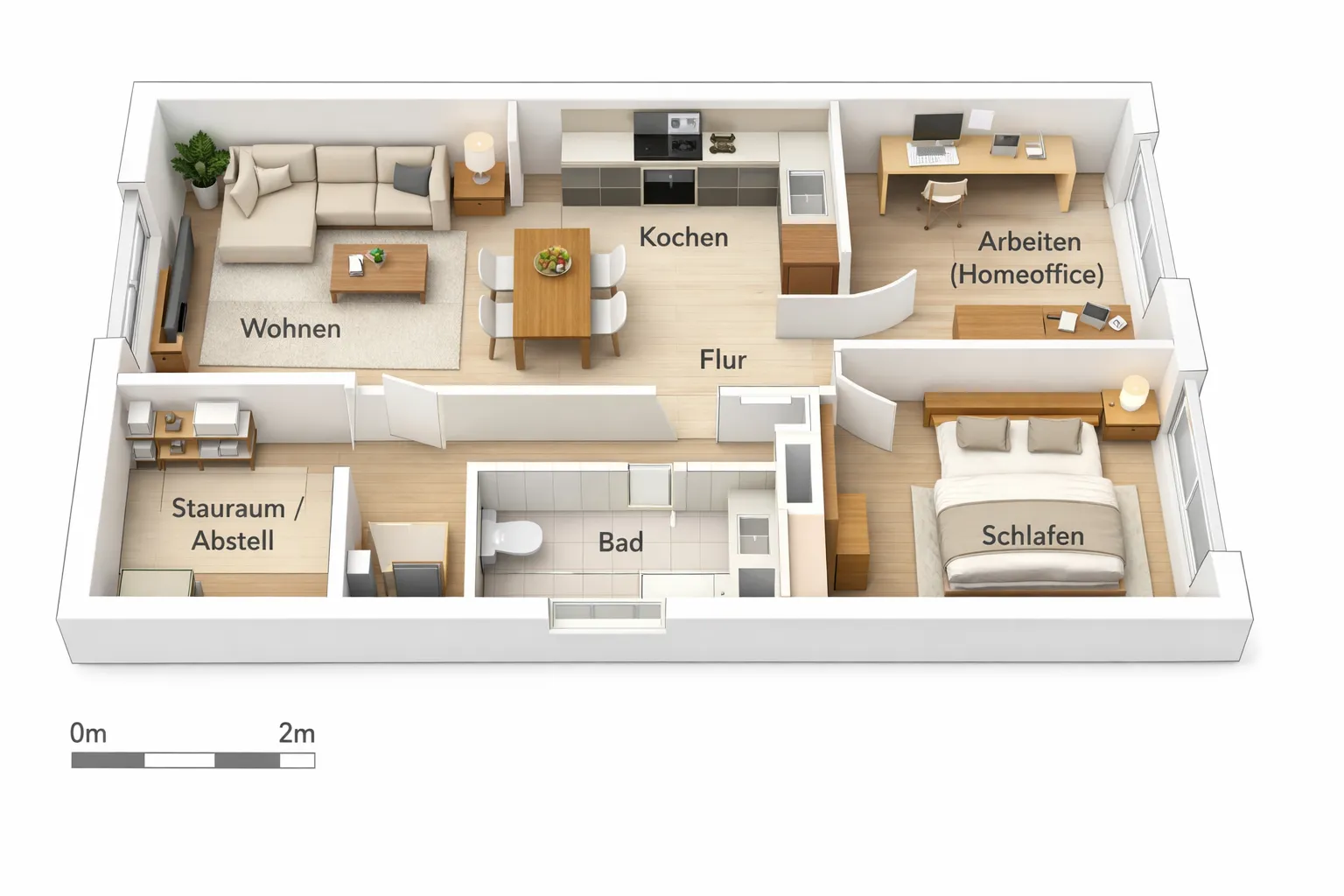
Digitale Werkzeuge sind starke Hebel zur Aufwertung Immobilien – vorausgesetzt, sie werden verantwortungsvoll eingesetzt. localis nutzt virtuelles Staging, 3D-Grundrisse und 360°-Touren dort, wo sie Orientierung schaffen, Reichweite erhöhen und Remote-Entscheidungen erleichtern.
Wann virtuelles Staging sinnvoll ist – und wann nicht
Sinnvoll:
Leerstand mit schwer lesbaren Proportionen.
Sanierungsfälle, um Potenziale sichtbar zu machen (Material-/Farbvorschläge).
Remote-Zielgruppen (international), wenn Show-Units nicht praktikabel sind.
Nicht sinnvoll:
Vermeintliche Mängel-Kaschierung (Täuschungsgefahr).
Stark abweichende Raumhöhen/Proportionen, die digital „geschönt“ würden.
Wenn reale Premium-Fotografie mit Basismöblierung verfügbar ist: Realität wirkt stärker.
Pflicht zur Kennzeichnung: Unterschiede zwischen Visualisierung und Realität
Transparenzpflicht: Virtuelle Bilder müssen klar als „Visualisierung“/„virtuelles Staging“ gekennzeichnet sein; reale Fotos sollten parallel gezeigt werden. Offene Kommunikation zu nicht real vorhandenen Elementen (z. B. Möbel, Beleuchtung, Oberflächen). Dadurch bleiben Vertrauen, Compliance und Verhandlungssicherheit erhalten.
3D-Grundrisse & 360°-Touren als Ergänzung, nicht als Ersatz
3D-Grundrisse: Räumliches Verständnis, Zonenführung (Wohnen, Arbeiten, Stauraum), Wege und Maßstäbe – ideal für schnelle Orientierung.
360°-Touren: Remote-Besichtigungen, Zeiteffizienz, bessere Vorqualifikation der Interessenten.
Wichtig: Beide sind Ergänzungen – die reale Fotostory und das physische Staging bleiben der Kern der Vermarktung.
Praxis-Tipp: Gleicher Blickwinkel für real vs. virtuell, um Vertrauen zu stärken
Nutzen Sie identische Kamerawinkel für:
Foto real (gestaged) vs. Render virtuell.
Vorher/Nachher-Slides mit gleichem Fokuspunkt (z. B. Esstisch/Kopfteil).
360°-Standpunkte, die mit den Fotoachsen übereinstimmen.
So verknüpfen Sie Erwartung und Realität, minimieren Rückfragen und stärken die Abschlusswahrscheinlichkeit – insbesondere bei internationalen Käufern und Investment-Cases. localis koordiniert die Produktion, Kennzeichnung und Einbindung dieser Assets, damit die Aufwertung von immobilien werte transparent, effizient und überzeugend gelingt.
Recht, Ethik und Dokumentation: Transparenz schafft Vertrauen und Preisstabilität
Professionelles Home Staging erhöht die Attraktivität – rechtssicher wird es durch saubere Offenlegung, vollständige Unterlagen und klare Kommunikation. So stabilisieren Sie Preis und Verhandlung – und wahren Ethik und Compliance im Sinne aller Beteiligten.
Mängel offenlegen statt kaschieren: Was Verkäufer rechtlich beachten sollten
Offenbarungspflichten: Ihnen bekannte, wesentliche Mängel (z. B. Feuchtigkeit/Schimmel, Hausschwamm, undichte Dächer, Asbest/Schadstoffe, nicht genehmigte Umbauten) proaktiv offenlegen. Arglistige Täuschung führt trotz Gewährleistungsausschluss zur Haftung.
Keine Kaschierung: Staging darf Mängel nicht verdecken. Kleinreparaturen/Neutralisierung sind zulässig; substanzielle Defekte gehören in das Exposé bzw. die Aufklärung im Vorfeld des Notartermins.
Baurechtliche Klarheit: Nutzungsänderungen, Anbauten, Dachausbau, Balkon/Loggia – nur mit nachweisbarer Genehmigung bewerben. „Schwarzbauten“ offenlegen, nicht als verkaufsrelevante Fläche ansetzen.
Vermietete Objekte: Staging und Fotografie nur mit Zustimmung der Mieter; Privatsphäre wahren (keine persönlichen Gegenstände/Personen erkennbar).
Energieausweis, WEG-Protokolle, Nachweise zu Modernisierungen: Unterlagen, die Vertrauen erzeugen
Energieausweis (GEG): In Anzeigen Pflichtangaben nennen (Endenergiebedarf/-verbrauch, Energieträger, Baujahr, Effizienzklasse). Bei Besichtigung vorzeigen; zum Notartermin bereithalten.
WEG-Unterlagen (bei ETW): Teilungserklärung, Nachträge, Protokolle der letzten 3 Jahre, Wirtschaftsplan, Jahresabrechnung, Höhe der Instandhaltungsrücklage, laufende/beschlossene Maßnahmen, Sonderumlagen.
Technische Nachweise: Wartungsprotokolle (Heizung, Aufzug), Schornsteinfegerbescheinigungen, E‑Check/Elektroprüfungen, Dichtheitsprüfungen, Belege zu Modernisierungen (Rechnungen, Garantien, Herstellerunterlagen).
Flächen & Pläne: Grundrisse mit Quelle/Stand; Wohnflächenberechnung (WoFlV) schlüssig dokumentieren. Abweichungen klar benennen.
Denkmalschutz/Ensembleschutz: Bescheide und Auflagen beifügen; Modernisierungsmaßnahmen entsprechend kennzeichnen.
Fotorechte, Leihmöbel-Verträge, Versicherung für Einbauten während der Vermarktung
Fotorechte: Mit dem Fotografen schriftlich Nutzungsrechte klären (Medien, Dauer, Bearbeitung/virtuelles Staging, 3D/360°). Logos/Marken im Bild möglichst vermeiden; Musikrechte für Videos (GEMA-frei/Lizenz).
Virtuelle Bearbeitung: Retuschen, die über Helligkeit/Farbe hinausgehen (z. B. Entfernen von Mängeln), nur mit ausdrücklicher Kennzeichnung verwenden.
Leihmöbel/Mietdekor: Vertraglich regeln – Mietdauer (typ. 8–12 Wochen), Verlängerungsoption, Zustandsprotokoll, Haftung/Selbstbehalt, Kaution, Transport/Etagenzuschläge, Versicherung (Diebstahl/Schäden).
Versicherung & Sicherheit: Prüfen Sie Betriebshaftpflicht des Stagers/Handwerker; Verkehrssicherungspflichten bei Besichtigungen (Stolperfallen, Kabel sichern, stabile Aufbauten). Für hochpreisige Stücke ggf. separate Valoren-/Transportversicherung.
Kommunikation im Exposé: Klartext zu Staging-Umfang, virtuellen Visualisierungen und Abweichungen
Staging-Transparenz: Umfang kurz beschreiben (welche Räume real gestaged, Mietmöbel/Accessoires temporär). Keine falschen Erwartungen wecken.
Virtuelles Staging/Renderings: Deutlich kennzeichnen („Visualisierung“), reale Vergleichsfotos derselben Perspektive zeigen; abweichende Elemente benennen (Materialien/Möbel sind Vorschläge).
Bildethik: Keine übertriebenen Weitwinkel-/HDR-Effekte, die Größen-/Lichtsituationen verfälschen. Konsistente Weißbalance und realistische Farbdarstellung stärken Vertrauen.
Flächen & Funktionen: Möblierungen sind exemplarisch; Grundrisse „nicht maßstabsgetreu“ nur, wenn kenntlich gemacht. Bei Investment-Cases Ertragsannahmen und Quellen angeben.
Datenschutz & Privatsphäre: Vor Fotos/Besichtigungen persönliche Daten/Porträts entfernen; vorhandene Kameras/Smart-Home-Aufzeichnung deaktivieren. Lead-Management DSGVO-konform.
localis verbindet Staging immobilien mit rechtlich sauberer Dokumentation und klarer Kommunikation. Das schafft Vertrauen, senkt Rückfragen, reduziert Preisabschläge – und stabilisiert immobilien werte im gesamten Vermarktungsprozess. Als Service immobilien übernehmen wir die Koordination aller Partner, die Prüfung der Unterlagen und die präzise Exposé-Sprache, damit Ihr Verkauf sicher, überzeugend und wertstark gelingt.
Praxis-ROI: Fallbeispiele aus Düsseldorf, Paris und Dubai
„Staging ist kein Selbstzweck. Richtig eingesetzt erhöht es die Verhandlungssicherheit und öffnet Türen zu Off-Market-Bieterprozessen – die Kombination aus Aufwertung und Zugang entscheidet.“ – localis consulting (Beratungsteam)
Mit klaren Maßnahmen und sauberem Projektmanagement hebt Home Staging den wahrgenommenen Wert, steigert die Nachfrage und verkürzt die Vermarktungszeit. Die folgenden Beispiele zeigen, wie wir staging immobilien als wirkungsvollen Hebel für die Aufwertung von immobilien werte einsetzen – und welche Elemente sich auf andere Märkte übertragen lassen.
Case 1 (Düsseldorf): Altbau, bewohnt, 1,1 Mio € Ziel – 1,6 % Staging, +6,8 % Verkaufspreis, < 30 Tage Marktzeit
Ausgangslage: Charismatischer Altbau (ca. 120 m²), bewohnt, stark personalisiertes Interieur. Ziel: rasche, verhandlungssichere Platzierung im oberen Segment.
Maßnahmenmix:
Ein-Tages-Staging mit Depersonalisierung, Kabelmanagement, Textil- und Licht-Update (3000–3500 K).
Neutralisierung im Wohn-/Essbereich und Primary Bedroom (Hotel-Anmutung, Symmetrie).
Premium-Fotografie, annotierter Grundriss, präzise Bildreihenfolge (Hero-Shot → Key Feature → Bedroom).
Budget/ROI:
Staging-Budget: 1,6 % vom Zielpreis (≈ 17.600 €).
Ergebnis: +6,8 % Verkaufspreis gegenüber Ziel (≈ +74.800 €), Netto-Mehrerlös ≈ 57.200 €, ROI ≈ 3,25x.
Marktzeit: Unter 30 Tagen; reduzierte Nachverhandlungen dank klarer Raumfunktionen.
Übertragbarkeit: Klare Priorität auf Key Rooms, konsistente Weißbalance, schlanker Maßnahmenplan mit maximalem Fotoleverage.
Case 2 (Paris): Pied-à-Terre im Premiumsegment – kuratiertes Licht/Textil, Off-Market-Bieterprozess
Ausgangslage: 2-Zimmer-Pied-à-Terre in 7e/16e, stilvolle Substanz, aber optisch uneinheitlich. Ziel: internationale Käuferschicht, diskret und preisstabil.
Maßnahmenmix:
Kuratierte Textilien (Leinen, Wolle), dezente Kunst, Lichtführung mit Akzentleuchten und Dämmerungsfotografie.
Reduzierte Farbpalette (Greige/Weiß, 10 % Akzent), Fokus auf Blickachsen zu Fenstern/Balkon.
Off-Market-Teaser über IMAG Netzwerk, kuratierte Erstbesichtigungen in Clustern (Back-to-back).
Ergebnis:
Mehrfachgebote im geschlossenen Verfahren; Zuschlag über Erwartungswert, minimaler Preisnachlass.
Starke Bildperformance, hohe Conversion von Anfrage zu Besichtigung.
Übertragbarkeit: In Premiumlagen wirken Materialität, Lichtinszenierung und knappe Distribution stärker als eine breite Portal-Strategie.
Case 3 (Dubai): Leerstand im Investment-Highrise – standardisierte Module, schnelles Turnaround
Ausgangslage: Neubau-Highrise, 1-Bed-Investment-Unit, leerstehend. Ziel: schneller Verkauf an renditeorientierte Käufer (regional/international).
Maßnahmenmix:
Standardisierte Staging-Module: Basismöblierung (Wohnen/Essen/Primary Bedroom), Akustik-Teppiche, neutraler Kunst-/Grünakzent.
3D/360°-Tour und zweisprachiges Exposé; Investment-Notizen (Miete, Service Charges, Yield).
Batch-Fotografie für konsistente Serie; identische Blickwinkel für Vertrauen.
Ergebnis:
Kurzer Turnaround (Go-live bis Annahme des Angebots in wenigen Wochen), wenige Preiszugeständnisse.
Remote-Entscheidung dank 3D/360°; reduzierte Besichtigungszahl bei höherer Lead-Qualität.
Übertragbarkeit: Für Investment-Cases zählen Standardisierung, digitale Assets und klare KPI-Kommunikation – aufwertung immobilien durch Effizienz und Messbarkeit.
Lessons Learned: Welche Hebel in welchem Marktumfeld konstant funktionieren
Hero-Shots bestimmen den Takt: Erstes Bild festigt die Preisanker – Lichtführung und Linienklarheit sind nicht verhandelbar.
Key Rooms zuerst: Wohn-/Essbereich, Primary Bedroom, bestes Bad – dort entsteht der Mehrpreis; Nebenräume minimalistisch.
Konsistente Farbharmonie: Einheitliche Weißbalance und reduzierte Palette signalisieren Qualität und vermeiden Reibung.
Grundriss + 360° als Vertrauensbooster: Ergänzung zur Fotostory, keine Ersatzhandlung – identische Blickwinkel real vs. virtuell.
Cluster-Besichtigungen: Verdichtung erzeugt Marktimpuls, senkt Verhandlungsspielräume.
Realistischer Angebotspreis + Staging: Kombination schafft Verhandlungssicherheit und öffnet Wege in Off-Market-Bieterprozesse.
Standardisierte Service-Module: In Investment- und Projekt-Setups sichern wiederholbare Qualität, Kostenkontrolle und schnellere Marktreife.
localis verbindet professionelle Inszenierung mit exklusivem Zugang – als Service immobilien, der Nachfrage bündelt, Preisstabilität schafft und immobilien werte planbar steigert.
Fazit & nächste Schritte mit localis: Vom Staging zur strukturierten Vermarktung
Home Staging ist kein Selbstzweck – es ist ein strategischer Hebel, um Angebotspreise zu stützen, Verhandlungssicherheit zu erhöhen und immobilien werte planbar zu heben. Wer jetzt konsequent auf Inszenierung, klare Bildführung und saubere Dokumentation setzt, reduziert Marktzeit, schützt den Preis und erzielt bessere Nettoergebnisse. localis bündelt diesen Ansatz in einem strukturierten Prozess – von der Analyse bis zum Closing.
Warum jetzt handeln? Marktfenster nutzen, Kapitalbindung reduzieren, Inflationsschutz sichern
Kürzere Vermarktungszeit: Gut vorbereitete Listings drehen schneller – Liquidität kehrt früher zurück, Kapitalbindung sinkt.
Preisstabilität trotz Wettbewerb: Professionelles Staging immobilien verschiebt die Wahrnehmung nach oben und verringert Abschläge.
Inflationsschutz durch Sachwertlogik: Wer Werte effizient realisiert und reinvestiert, profitiert doppelt – durch Zeit- und Preisvorteile.
First-mover-Effekt: Qualitativ führende Exposés erzeugen Blickvorteile auf Portalen und in Netzwerken – Nachfrage bündelt sich früh.
Unser Service-Framework (localis): Analyse → Staging-Konzept → Exposé/360° → Off-Market-Ansprache (IMAG) → Bieterprozess → Closing
Analyse: Objekt- und Zielgruppen-Check, Status-Quo-Bewertung, Preisstrategie.
Staging-Konzept: Maßnahmenplan nach Raumwirkung (Key Rooms), Budget 1–3 %, Zeitplan (14 Tage möglich).
Exposé/360°: Premium-Fotografie, 3D-Grundrisse, 360°-Tour, redaktionelle Textmodule – konsistente Bild- und Wortmarke.
Off-Market-Ansprache (IMAG): Zugang zu vorqualifizierten Käufern – ideal für Premium- und Luxus-/Auslandsobjekte.
Bieterprozess: Clustern der Ersttermine, sauberes Angebotsmanagement, transparente Kommunikation.
Closing: Verhandlungsführung, Unterlagen-Check, Notartermin, After-Sales-Übergabe.
Ergebnis: Messbare aufwertung immobilien mit klarem ROI – online sichtbar, vor Ort überzeugend.
Vorteile mit localis: Exklusiver Off-Market-Zugang, 15+ Jahre Erfahrung, internationale Diversifikation, stabile Renditeziele, Top-Kundenzufriedenheit (5,0/5)
Exklusiver Zugang: IMAG-Broker-Netzwerk mit Off-Market-Optionen und frühzeitigen Käuferzugängen.
Erfahrung & Präzision: 15+ Jahre in Luxus- und Investmentmärkten (Düsseldorf, Paris, Zypern, Schweiz, Dubai).
Internationaler Blick: Diversifikation über Märkte und Anlageklassen – für Risiko- und Währungsschutz.
Renditeziele im Blick: Je Segment abgestimmt (z. B. 4–8 % p.a. bei Investment-Strategien).
Vertrauensbasis: 5,0/5 Kundenzufriedenheit – Prozesse, die klar, transparent und effizient sind.
Ganzheitlicher service immobilien: Von Home Staging über Marketing-Assets bis zum strukturierten Bieterprozess.
Call-to-Action: Unverbindliches Erstgespräch, Budgetplanung (1–3 %), ROI-Simulation für Ihr Objekt, Start in 14 Tagen möglich
Unverbindliches Erstgespräch: 30 Minuten zur Zielklärung und Grobanalyse.
Budgetplanung: Wir kalkulieren ein Staging-Budget von 1–3 % abgestimmt auf Ihre Objektklasse.
ROI-Simulation: Szenarien zu Mehrerlös, Marktzeit und Verhandlungsspannen – belastbar und transparent.
Go-to-Market in 14 Tagen: Umsetzung nach Plan – von Entrümpelung und Neutralisierung bis zu Exposé, 360° und Off-Market-Ansprache.
Nächster Schritt: Kontakt aufnehmen, Kurz-Check senden (Adresse, Grundriss, 5–10 Fotos) – wir liefern innerhalb von 48 Stunden einen Maßnahmen- und Zeitplan.
Mit localis verwandeln Sie Inszenierung in Ergebnis: bessere Bilder, bessere Leads, bessere Preise. Sichern Sie sich jetzt Ihr Marktfenster – wir führen Sie vom Staging zur strukturierten Vermarktung bis zum erfolgreichen Closing.